Massive sulphide deposits at Sandiego and Onedin are hosted by the Koongie Park Formation comprising mafic and felsic volcanics, associated sediments including sandstone, mudstone, carbonate, chert and ironstone, and is intruded by rhyolitic to rhyodacitic sills, dolerite bodies and basalt dykes. Massive sulphide mineralisation is strata-bound, with disseminated sulphides overlaying the massive sulphides. Both deposits are interpreted to occur within the limbs of intensely folded, higher order, double-plunging anticlinal structures.
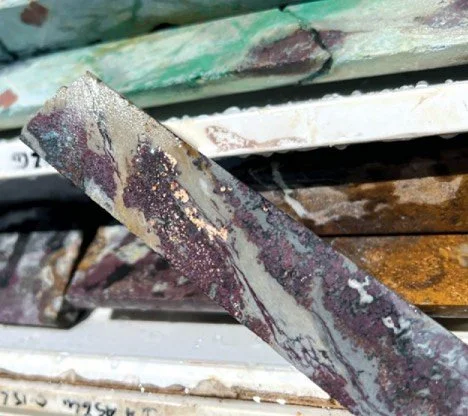
The sulphide deposits of Koongie Park are classified as Volcanogenic Massive Sulphide (‘VMS’) deposits. The mineralogy of the primary mineralisation at Sandiego is pyrite-sphalerite-pyrrhotite-chalcopyrite +/- galena, which is largely hosted in the magnetite-rich exhalative suite of rocks where it occurs as a massive conformable wedge-shaped lens 200m in length with a maximum thickness of 75m. At Onedin, sphalerite is the main sulphide in the primary mineralisation with subordinate pyrrhotite-pyrite-chalcopyrite-galena. Onedin comprises numerous stacked lenses of mineralisation with a folded and faulted geometry over a vertical extent of 400m.
Both deposits have a deep weathering profile (up to 250m below the surface), resulting in three weathering domains: an oxidised zone at the surface, a primary zone at depth, and a transition zone in between.