
Why this Moment Matters for the Cobalt Market
The cobalt market is experiencing a rare convergence of forces that represent a structural shift likely to define the next several years. The US government and some of its allies are deploying real capital to rebuild critical mineral supply chains. Demand is accelerating across EVs, e-bikes, micromobility, drones, defence, and energy storage — the last of these turbocharged by the digital capex cycle powering AI data centres. And the world's dominant cobalt-producing nation has fundamentally reset the terms on which it supplies the market.
Cobalt Blue sits at the intersection of all three of these dynamics, positioned to capitalise on this moment to become a critical minerals supplier.
The Policy Signal Is Unambiguous
The White House recently announced over US$2 billion in critical minerals investments, alongside new restrictions on defence industry imports of critical minerals from non-allied nations. The message is clear: the US is serious about rebuilding supply chains it can no longer afford to leave exposed, and it is deploying capital today to do it. Notably, the largest allocations in the package went not to mines, but to processing, refining, and battery manufacturing — precisely the segment of the supply chain where Cobalt Blue operates. This is the policy environment the industry has been waiting for, and it is now a reality.
Demand — Electrification Continues to Spark
The digital capex cycle is creating a new source of demand across EVs, e-bikes, micromobility, drones, defence, and energy storage. A recent standout has been EV sales in Europe. Pure electric vehicle sales are up 35% year-on-year and plug-in hybrids up 25%, with other regions also reporting strong growth as volatile petrol prices add a new layer of urgency to the consumer shift to electric.
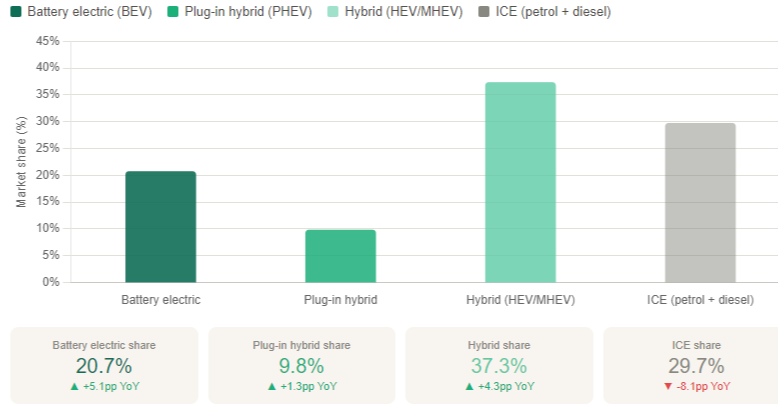
Source: ACEA — H1 2026 EU new car registrations. Hybrid = HEV + MHEV. ICE = petrol + diesel.
Europe is particularly significant for cobalt: NMC chemistry dominates in the region due to its superior range and performance characteristics, and EU recycled content legislation structurally disadvantages LFP — which relies on low-value iron phosphate inputs that are rarely worth recycling. NMC demand, and with it demand for battery-grade cobalt sulphate, is building steadily.
Supply — The DRC Quota Picture Is Crystallising
As we approach the one-year mark since the DRC introduced its export quota system, the supply picture is becoming clearer — and it is tighter than many anticipated. After producing approximately 190,000 tonnes in 2024, full-year 2026 export volumes look likely to come in well under the 96,600 tonne allocation. With unused H1 quotas now forfeited rather than carried forward, the ability to make up lost ground in H2 is gone. The quota system is expected to remain in place through 2027, meaning supply tightness is a structural feature of the market for at least the next 12–18 months.
China's customs data illustrates the impact. Imports of cobalt intermediate products collapsed to just 2,584 tonnes (metal content) in May — down 95% year-on-year — before recovering sharply to 10,961 tonnes in June as DRC miners resumed shipments and port backlogs began to clear. Even so, June imports remained 42% below the same month in 2024.
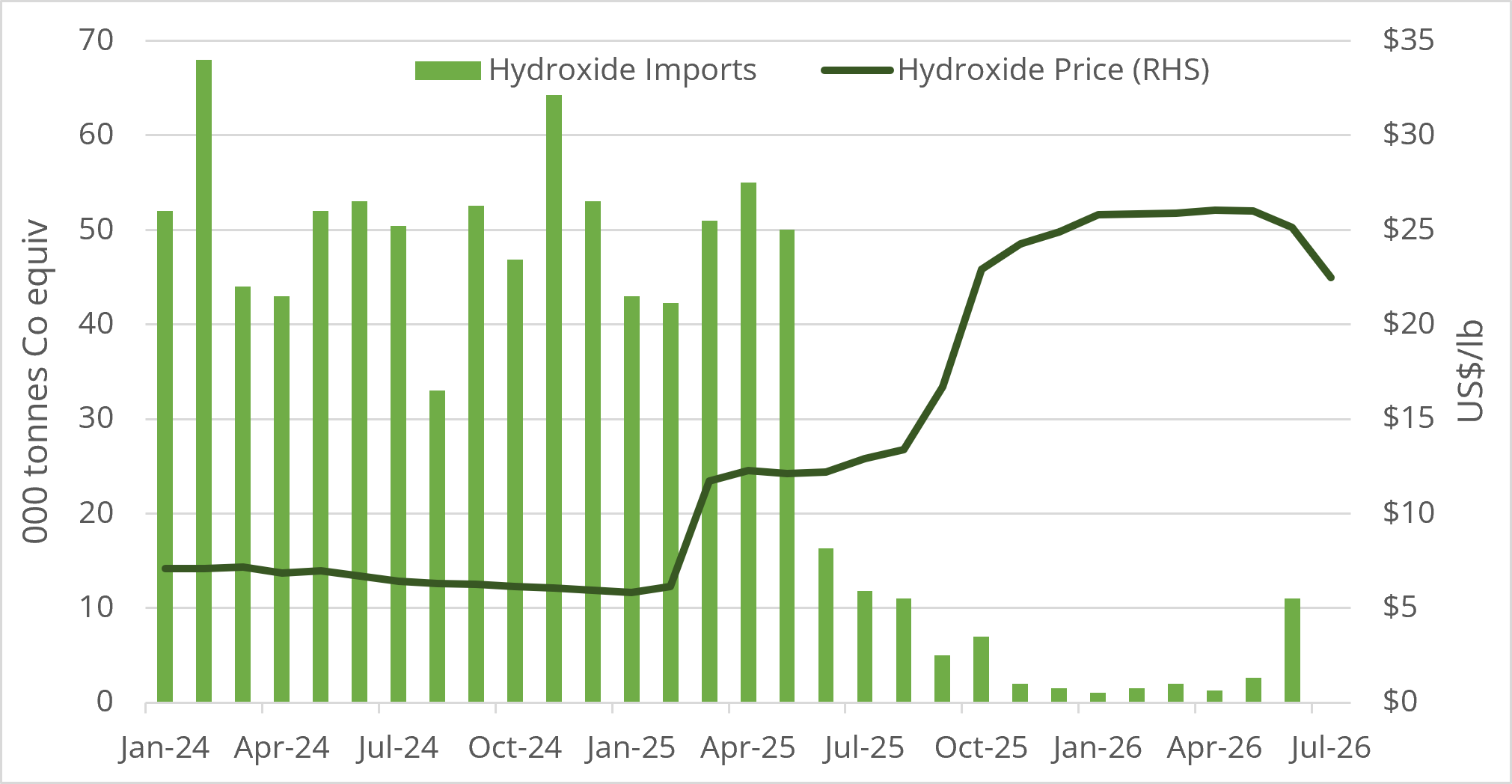
Source: Fastmarkets, China's General Administration of Customs, Cobalt Blue Holdings
The partial recovery is providing much-needed relief to consumers. Since September 2025, hydroxide has been trading at or near parity with refined cobalt metal as a result of tight supply availability — an almost unprecedented dynamic, given that hydroxide normally trades at a 20–30% discount reflecting the additional refining steps required to convert it to a finished product. The normalisation of this spread remains a key market indicator to watch as June shipments arrive in China through July and August.
Cobalt Blue's Position
Cobalt Blue sits at the intersection of all three of these dynamics — policy capital flowing into processing and refining, growing global electrification and industrial demand, and a structural supply deficit that shows no signs of resolving before 2028 at the earliest.
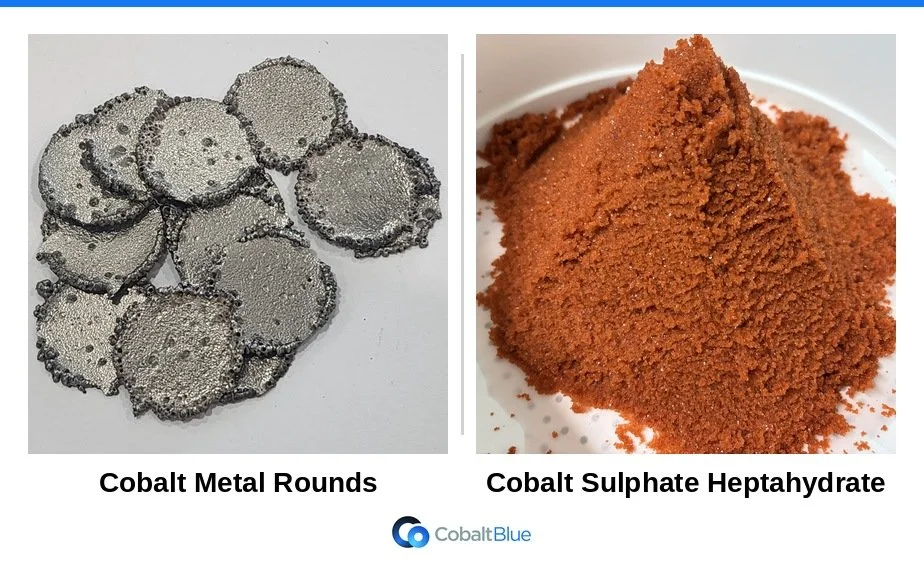
Our immediate priority is the Kwinana Cobalt Refinery — Australia's first dedicated cobalt refinery — designed to produce high-purity cobalt sulphate for the battery industry and high-grade cobalt metal for advanced manufacturing and defence applications. KCR is a multi-feedstock facility, giving it the flexibility to source intermediates from multiple origins as the supply landscape evolves. The Broken Hill Cobalt Project will follow, ultimately establishing a fully integrated, mine-to-refinery cobalt supply chain on Australian soil — sovereign, reliable, and aligned with the needs of battery manufacturers and governments seeking alternatives to concentrated supply chains.
The convergence of policy capital, demand growth, and structural supply constraint is creating the conditions Cobalt Blue was built for.