
US EV demand is rebounding from the tax credit shock of late 2025, driven by rising oil prices and improving affordability. Cobalt Blue is building the supply chain infrastructure that the evolving EV battery market requires.
Below we discuss what the data says about US EV demand, what it means for battery chemistry, and why the picture is more positive for cobalt than the headlines of twelve months ago suggested.
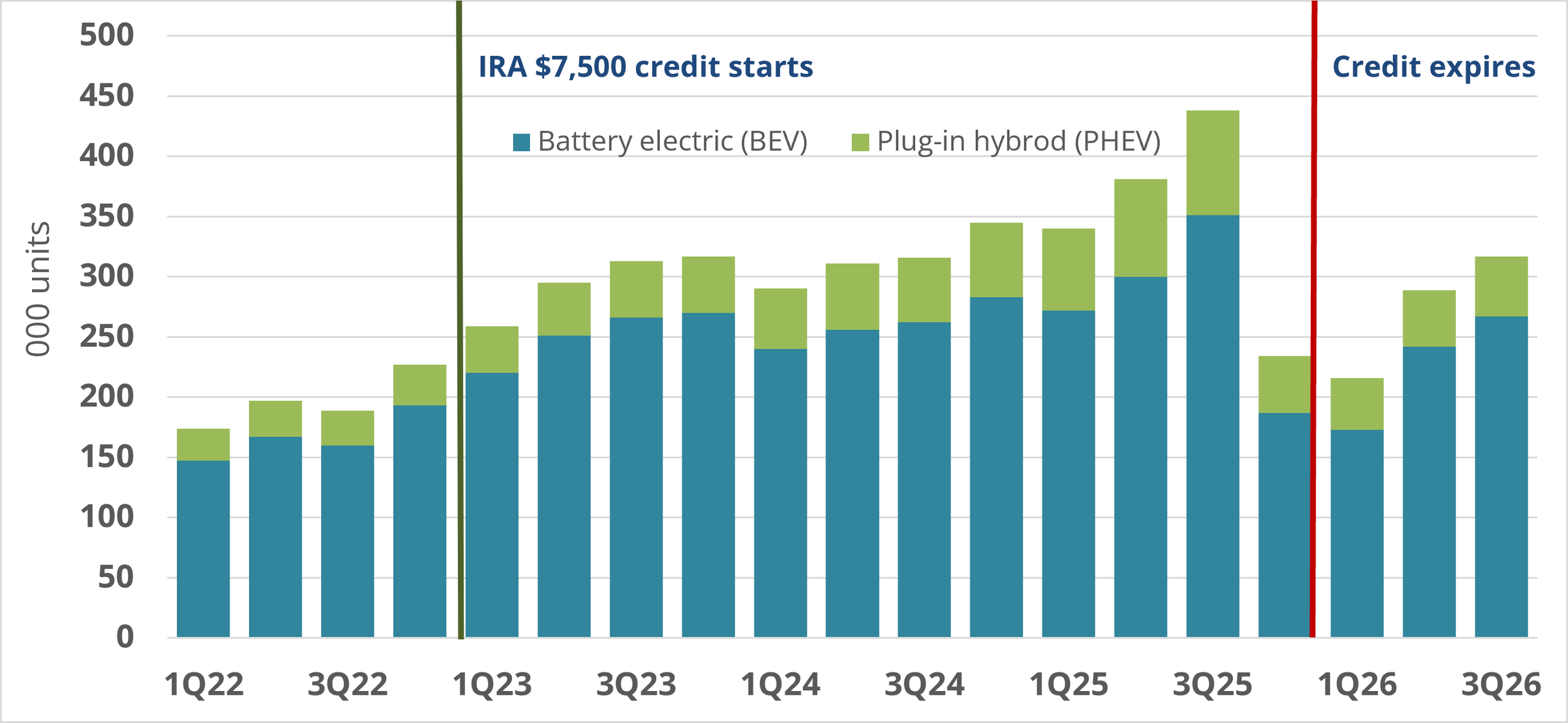
A year ago, the US EV market was in freefall. The expiry of federal tax credits at the end of 2025 triggered the sharpest quarterly sales decline in the market's history. By Q4 2025, sales had collapsed 46% from Q3's record high. Analysts revised forecasts downward. The narrative shifted from EV optimism to EV anxiety.
That narrative has now changed again. Consumer sentiment is recovering and used EV prices have converged with petrol equivalents. But perhaps the strongest tailwind has arrived from turbulence in the global oil market following conflict in the Middle East from early 2026. The case for EVs, already improving on cost grounds, has become significantly more compelling.
The Tax Credit Shock - and What Followed
The mechanics of the 2025 US EV tax credit expiry were always going to create a distortion. The IRA's $7,500 consumer credit drove a surge in pull-forward demand through Q3 2025, with sales hitting a record 438,487 units in the quarter, +41% from Q2 and nearly 30% above the prior year. When the credit expired on 31 December 2025, the floor dropped out.
Source: Cox Automotive / KBB, Urban Science, CarEdge, Cobalt Blue Holdings
Fast-forward to 2026, and underlying demand is now stronger than before the IRA tax credit. While used EV prices have converged with comparable ICEs, the most significant development for US EV demand has come from the oil price shock following the start of US military strikes in Iran.
Oil Prices Change the Calculation
Higher petrol prices shift the total cost of ownership equation decisively in favour of EVs, and consumers have noticed. Cox Automotive data from mid-2026 shows that EV shopping consideration has risen 69% since January, with consideration for non-luxury EV SUVs up 96%.
This is not a minor shift in sentiment. It is a structural re-rating of the EV value proposition driven by the most durable of economic motivations: fuel costs. To date, the EV market has expanded mainly among higher-income, environmentally motivated buyers. However, the oil shock is reaching a broader segment of the purchasing population.
History supports the view that oil shocks have lasting effects on automotive preferences. Every major crude price spike since the 1970s has been followed by a structural shift in powertrain preferences that outlasted the immediate supply disruption. The 2026 shock is more targeted than a global embargo, but the consumer response appears consistent with the pattern.
The European Signal
The US recovery is occurring alongside an accelerating European transition that provides an important forward view. European EV markets tend to lead the US by 18–24 months on regulatory-driven adoption, and the H1 2026 European data is unambiguous.
Source: ACEA - H1 2026 EU new car registrations, Cobalt Blue Holdings
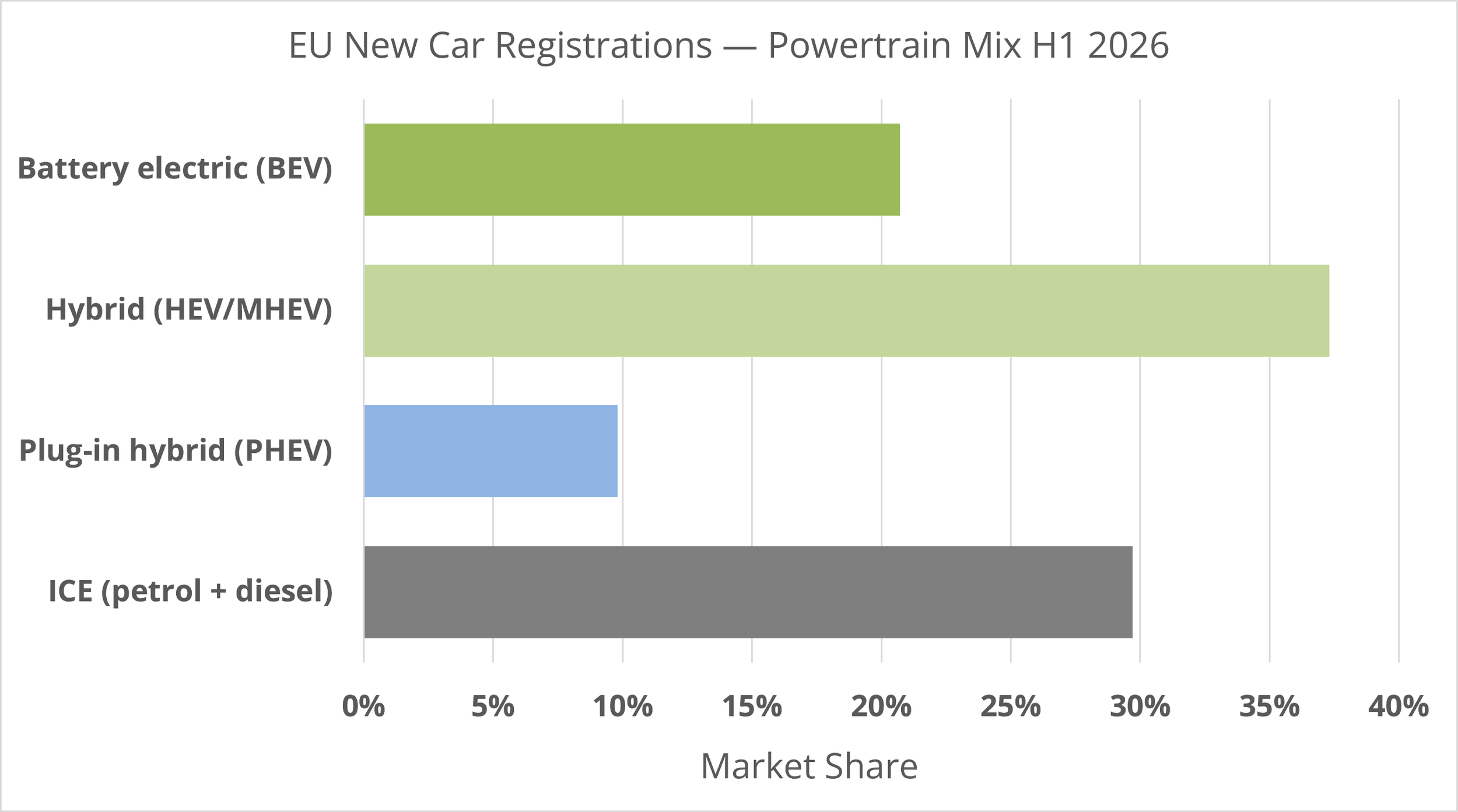
Pure electric vehicles now account for 21% of European new car sales (+5.1% YoY), with plug-in hybrids adding another 10%. Combined electrified powertrains (including mild and full hybrids) account for more than 70% of all new car registrations. ICE's share has fallen to under 30%.
The European trajectory is the most likely path for the US market over the coming decade. US policy frameworks are less prescriptive than Europe's, but consumer preferences, particularly when shaped by fuel economics, tend to converge across developed markets over time.
Battery Chemistry: Why NMC Wins in the Markets That Matter
Not all EV demand is equal for cobalt. The battery chemistry divide between LFP and NMC is the most consequential variable in the cobalt demand outlook, and it cuts differently across markets. See our Cobalt Market 101 for a more fullsome discussion.
LFP (lithium iron phosphate) batteries - cheaper and cobalt-free - have captured mass-market volume in China and are gaining share in entry-level segments globally. NMC (nickel manganese cobalt) remains the chemistry of choice for premium vehicles, long-range platforms, and markets where performance characteristics command a price premium.
The US market is structurally favourable for NMC
First, the US premium vehicle segment is large relative to other markets, and NMC's energy density advantage, supporting ranges of 600–1,000km versus LFP's typical 400–500km, is a material differentiator in a market where consumers tend to prioritise range and performance. Tesla, the market's dominant player, uses NMC chemistry across its longer-range platforms; Hyundai's IONIQ range, Polestar, and Mercedes-Benz all run NMC.
Second, unlike Europe, the US does not yet have binding recycled content mandates for battery materials. The EU Battery Regulation creates a structural disadvantage for LFP in Europe, iron phosphate inputs have little scrap value and are rarely recycled, meaning LFP manufacturers face mounting compliance costs under recycled content thresholds. US manufacturers and OEMs choosing chemistry today are doing so on performance and cost grounds, and on those metrics NMC remains competitive for the segments where volume and margin are highest.
Third, the alignment of US policy, under both the Inflation Reduction Act framework and recent critical minerals directives, with allied supply chains creates an incentive for manufacturers sourcing from US-friendly jurisdictions to use battery chemistries that leverage those relationships. Cobalt, sourced from Western-aligned processing facilities, is part of that calculus.
Cobalt Blue's Position
Cobalt Blue is building the supply chain infrastructure that the evolving EV battery market requires, and doing so at a moment when Western governments are deploying significant capital to establish allied alternatives to DRC and Chinese-controlled supply chains.
The Kwinana Cobalt Refinery (KCR), Australia's first dedicated cobalt refinery, is designed to produce high-purity cobalt sulphate for the battery industry and high-grade cobalt metal for advanced manufacturing applications. KCR is a multi-feedstock facility, giving it the flexibility to source intermediates from multiple origins as the global supply landscape evolves. Recent technical milestones and successful product qualification have validated the refinery's design and reinforced the project's pathway toward development.
The Broken Hill Cobalt Project (BHCP) will follow, ultimately establishing a fully integrated, mine-to-refinery cobalt supply chain on Australian soil. BHCP hosts one of the largest cobalt deposits outside the DRC, with cobalt mineralisation embedded in sulphur-rich pyrite that underpins the company's patented processing technology. At current sulphur price levels, BHCP's sulphur co-product transitions from a minor line item to a meaningful contributor to project economics.
The convergence of recovering EV demand, NMC chemistry's structural position in premium markets, US policy alignment with allied supply chains, and a tightening DRC supply picture is precisely the environment Cobalt Blue was designed for.